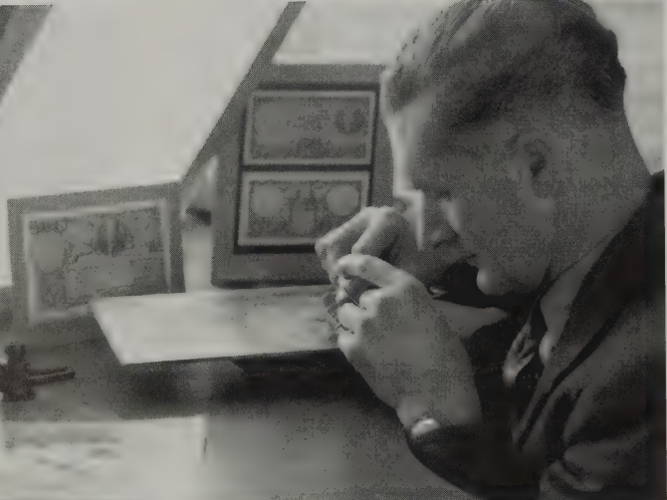
Adrian Arthur Senger (1926 ~ 2016)

He is the graphic designer of the 20,000 Lira banknotes from the seventh emission group, which depict the Central Bank of Turkey Headquarters on the reverse, and the 50,000 Lira banknote, which features the Turkish Grand National Assembly composition (*1).
These two banknotes are the last banknotes whose designs were created by a foreign artist. The original designs for the banknotes were created in Türkiye by watercolor artist and graphic designer Adrian Arthur Senger, while the engravings, films, and plates were produced in Switzerland, at De La Rue Giori.


Senger studied at the Akademie der Bildenden Künste München (Munich Academy of Fine Arts). From 1959 to 1971, he worked as a graphic artist at the Giori firm in Milan.

From 1960 to 1962, he studied banknote and document design at the Accademia di Belle Arti di Brera (Brera Academy of Fine Arts). From 1979 to 1987, he worked as a graphic designer and art consultant at De La Rue Giori in Lausanne, Switzerland. He also contributed to the design of the Deutsche Mark banknotes (*2).

[1] TCMB LİRA Bülteni, Ocak 2009 Sayı: 49, “1927’den 2009’a Cumhuriyet Banknotları“, Hüseyin Şaşmaz (*51, s. 12).

[2] Adrian Arthur Senger – Wikipedia

Anthony Smith

Anthony Smith, who began working as an engraving apprentice at De La Rue in 1967, trained in portrait engraving with Harry Carradine until 1971, and then with Joseph Keen. In 1989, he joined Harrison & Son and worked there until the company was acquired by De La Rue in 1993 (*1).

He produced engravings for banknotes of Angola, Bahrain, United Arab Emirates, Botswana, Brunei, Cayman Islands, Gibraltar, Costa Rica, Dominican Republic, Ethiopia, Ghana, Guatemala, Haiti, Honduras, India, Hong Kong, Iraq, Northern Ireland, Jamaica, Jersey, Kenya, Lebanon, Lesotho, Madagascar, Malawi, Mozambique, Namibia, Nepal, Peru, Saudi Arabia, Somalia, Syria, Uganda, Yemen, and Zambia.

For Turkey, he created the engraving of the Izmir Clock Tower on the back of the 500 Lira banknote from the seventh emission.


[1] The International Engraver’s Line, Gene Hessler (*49, s. 254).

Phillip Goodwyn Hall (1905 ~ 1979)

Phillip Goodwyn Hall was an engraver who worked for Bradbury Wilkinson between 1939 and 1950, then for Waterlow and Sons, and finally for De Le Rue between 1961 and 1968 (*1).

He created engravings for banknotes of Brazil, Czechoslovakia, Guyana, Hong Kong, Iran, Nigeria, Paraguay, Scotland, Tanzania, Tonga, Lebanon, and New Zealand.

For Türkiye, he produced the engraving of the Manavgat Waterfall in Antalya on the reverse side of the E6 5 Lira banknote.


[1] The International Engraver’s Line, Gene Hessler (*49, s. 115).

Bohumil Heinz (1894 ~ 1940)

Bohumil Heinz (KAM po Česku)

Bohumil Heinz was a Czech artist, who was employed by the NBČS (Národní banka Československá / National Bank of Czechoslovakia) in Prague and also worked for De La Rue.

He engraved postage stamps for Czechoslovakia, Great Britain and her colonies, Greece and Sweden.

He also worked on the banknotes of several countries such as Bohemia & Moravia, Bahamas, Barbados, British Honduras, Czechoslovakia, China, Fiji, Iran, Jamaica, Malaya, New Zealand, Norway, Southern Rhodesia, Thailand and Uruguay.

For Turkey, he engraved the portrait of Mustafa Kemal Atatürk on the E2 series 2½, 5, 10, 50, 100, 500 and 1.000 lira banknotes (*1).


[1] The International Engraver’s Line, Gene Hessler (*49, p. 125).

Calligrapher Ahmet Bey

Calligrapher Ahmet was the creator of the texts on the first banknotes of the Turkish Republic. He used different calligraphy styles such as Diwani, Ruq’ah, Thuluth, Naskh, Taliq on different denominations of the banknotes that were printed in 1927 in London by the De la Rue printhouse.

The drawings of the banknotes were the handiwork of the painter Ali Sami Boyar, State Mint engraver Ismail Hasim was also among the team that was sent to London. *1.


[1] Cumhuriyet Gazetesine Göre Türkiye Cumhuriyeti’nin İlk Kâğıt Paralarının Basım Serüveni, Melek Öksüz, Tarih Dergisi – Turkish Journal of History, 81 (2023/3): 63-120


* Click here for the list of artists whose handiwork has contributed to Turkish Republic’s currency.

Engraver Ismail Hasim

Ismail Hasim was one of the Turkish State Mint engravers who was sent to London in 1927 to assist with the newly printed Turkish Banknotes at Thomas de la Rue. He and calligrapher Ahmet was among the team sent along Ali Sami Boyar (*1).


[1] The story of the first Banknotes of the Turkish Republic, told through the articles of Cumhuriyet Newspaper (Cumhuriyet Gazetesine Göre Türkiye Cumhuriyeti’nin İlk Kâğıt Paralarının Basım Serüveni, Melek Öksüz, Tarih Dergisi – Turkish Journal of History, 81 (2023/3): 63-120


* Click here for the list of artists who contributed to Turkish Republic’s currency.

Ali Sami Boyar (1880 ~1967)

Ali Sami Boyar is the designer of the first emission banknotes released in 1927 (*5 Sf.6).

He studied arts during middle school and later at the Naval Academy. He graduated the Naval Academy in 1901 and while working for the Navy, enrolled to Fine Arts School which he graduated in 1908.

In 1925, he won the contest for the first stamps of the Republic. Later in his career, while he was managing the Museum of Endowments (today Turkish and Islamic Arts Museum), he was appointed to produce the designs for the first banknotes of the republic.

He was sent to London to oversee the printing process along with the State Mint engraver İsmail Haşim and some other officials. The inscriptions on the banknotes were made by Calligrapher Ahmet in different font styles, so that it would be easier for the public to recognize different denominations. *1. The portrait on the 1000, 500 and 100 Lira banknotes was based on Atatürk’s photo taken at the Phebus Photo Studio by Bogos Tarkulyan(*2).

The series consisting of 1, 5, 10, 50, 100, 500 and 1.000 Lira denominations was printed in London Thomas de la Rue Printhouse.


The symbolism of the banknotes included Grey Wolf, Crescent and star, the new parliament in Ankara. The texts were still in the Turkish Arabic syntax and in traditional and partly kufic fonts.

Sources:

[1]Story of The Printing of The First Banknotes of the Turkish Republic According to The Daily Cumhuriyet, Melek Öksüz, Tarih Dergisi – Turkish Journal of History, 81 (2023/3): 63-120

[2] Belki Beni Tanıyamayacaksın: Lesser known photos and memoirs of Atatürk from Ömer Koç Collection

[3] Koleksiyon.org; article by Koray Tekay (“from an article from the book “75 Yılda Para’nın Serüveni” (adventures of our money in the last 75 years))

Some detailed biographies of the airtist (Turkish):